|
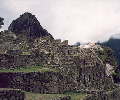
Maca, the only known cruciferous root crop of the Americas, is a hardy annual plant cultivated in the high altitudes of the Peruvian Andes. It is found growing specifically in areas of common frost occurrence and has one of highest frost tolerances among native cultivated species. It grows on the tundra, barren steppes, summits and high plateaus of the Peruvian Puna and Suni regions.
 |
Legend has it that Inca warriors would consume maca before entering into battle. This would make them extremely strong. But after conquering a city, the Incan soldiers were forbidden from using maca to protect the conquered women from the warrior's powerful sexual impulses!
From as far back as 500 years ago, maca's reputation for enhancing strength, libido and fertility was well established in Peru. |
These high Andean plateaus are an inhospitable region of intense sunlight, violent winds, and below-freezing weather. At altitudes of up to 14,000 to 16,000 feet above sea level, extreme temperatures and rocky soil, these unhospitable conditions rates it among the world’s worst farmland; yet, over the centuries, Maca has evolved to flourish under these conditions in this vitamin and mineral rich soil.
Formerly considered a perennial plant, it has since been discovered to be a self-fertilizing annual with a two-stage life cycle; a vegetative and reproductive cycle. Its appearance is accurately summed up as a shrub with a low-growing, mat-like stem system, small, off-white flowers, and scalloped leaves similar to others in the mustard family. It sometimes goes unnoticed in a farmer’s field. The root, can be one of several colors (crème, yellow, purple and black) and is of comparable shape to a turnip or radish (up to 8 cm). The plant is grown from seed, and root maturation generally occurs within seven to nine months.
The probable origin of the genus Lepidium has been traced back to the Mediterranean, where the majority of related diploid species (two similar complements of chromosomes) are found. As a food staple, Lepidium meyenii was likely domesticated in San Blas, Junin, between 1300-2000 years ago, by the Incas, and primitive cultivars of maca have been found in archaeological sites dating as far back as 1600 B.C.
To the Andean Indians and indigenous peoples, Maca is a valuable commodity.
Because so little else grows in the region, maca is often traded with communities at lower elevations for such other staples as rice, corn, green vegetables, and beans. The dried roots can be stored for up to seven years.
Native Peruvians traditionally have utilized maca since pre-Incan times for both nutritional and medicinal purposes. It is an important staple in the diets of these people, as it has the highest nutritional value of any food crop grown there. It is rich in sugars, protein, starches, and essential nutrients (especially iodine and iron). The tuber or root is consumed fresh or dried. The fresh roots are considered a treat and are baked or roasted in ashes (in the same manner as sweet potatoes). The dried roots are stored and, later, boiled in water or milk to make a porridge. They also are made into a popular sweet, fragrant, fermented drink called maca chicha. In Peru even maca jam, pudding, and sodas are popular. The tuberous roots have a tangy, sweet malty taste and an aroma similar to that of butterscotch.
The species L. meyenii was described by Gerhard Walpers in 1843. It has been suggested that the cultivated maca of today is not L. meyenii but a newer species L. peruvianum Chacon, based on various specimens collected since 1960 in the district of San Juan de la Jarpa, in Huancayo province.
While most maca sold in commerce today still refers to the L. meyenii name, economic botanists believe most is L. peruvianu. In 1994 less than 50 hectares (123.55 acres) were devoted to the cultivation of maca; by 1999 over 1200 hectares (2965.2 acres) were under production due to rising demand in the US and abroad.
Maca has been growing in world popularity over the last several years due to several large marketing campaigns touting its energizing, fertility enhancement, hormonal balancing, aphrodisiac, and, especially, enhanced sexual performance properties. Other (anecdotal) herbal-medicine uses include increasing energy, stamina, and endurance in athletes, promoting mental clarity, male impotence, and helping with menstrual irregularities, female hormonal imbalances, menopause.
Today, dried maca roots are ground to powder and sold in capsules as a food supplement and marketed to increase stamina (sexual and athletic) and fertility. In Peruvian herbal medicine, maca is also reported to be used as an immunostimulant.
The cultivation of maca is increasing in the highlands of the Andes to meet the growing demand worldwide; it is hoped that this demand will be sustained and not a trend of another passing fad. In this severely economically-depressed region, the market created for maca will offer new and important sources of income for the indigenous peoples of the Andes. About 10 cultivars there produce maca with different-colored roots; most are the same, hytochemically. The cultivar, Lepidium peruvianum Chacón has been identified in the major growing regions of the highlands and is the main variety of choice for expanded cultivation today. It will likely supply much of this new demand.
_______________________________________________
FDA-Required Statement: Information on this site is provided for informational purposes and is not meant to substitute for the advice provided by your own physician or other medical professional. You should not use the information contained herein for diagnosing or treating a health problem or disease, or prescribing any medication. You should read carefully all product packaging. If you have or suspect that you have a medical problem, promptly contact your health care provider. Information and statements regarding dietary supplements have not been evaluated by the Food and Drug Administration and are not intended to diagnose, treat, cure, or prevent any disease.
Maca Live™ is not recommended for women on birth control.
We cannot guarantee that you will not get pregnant.
|